
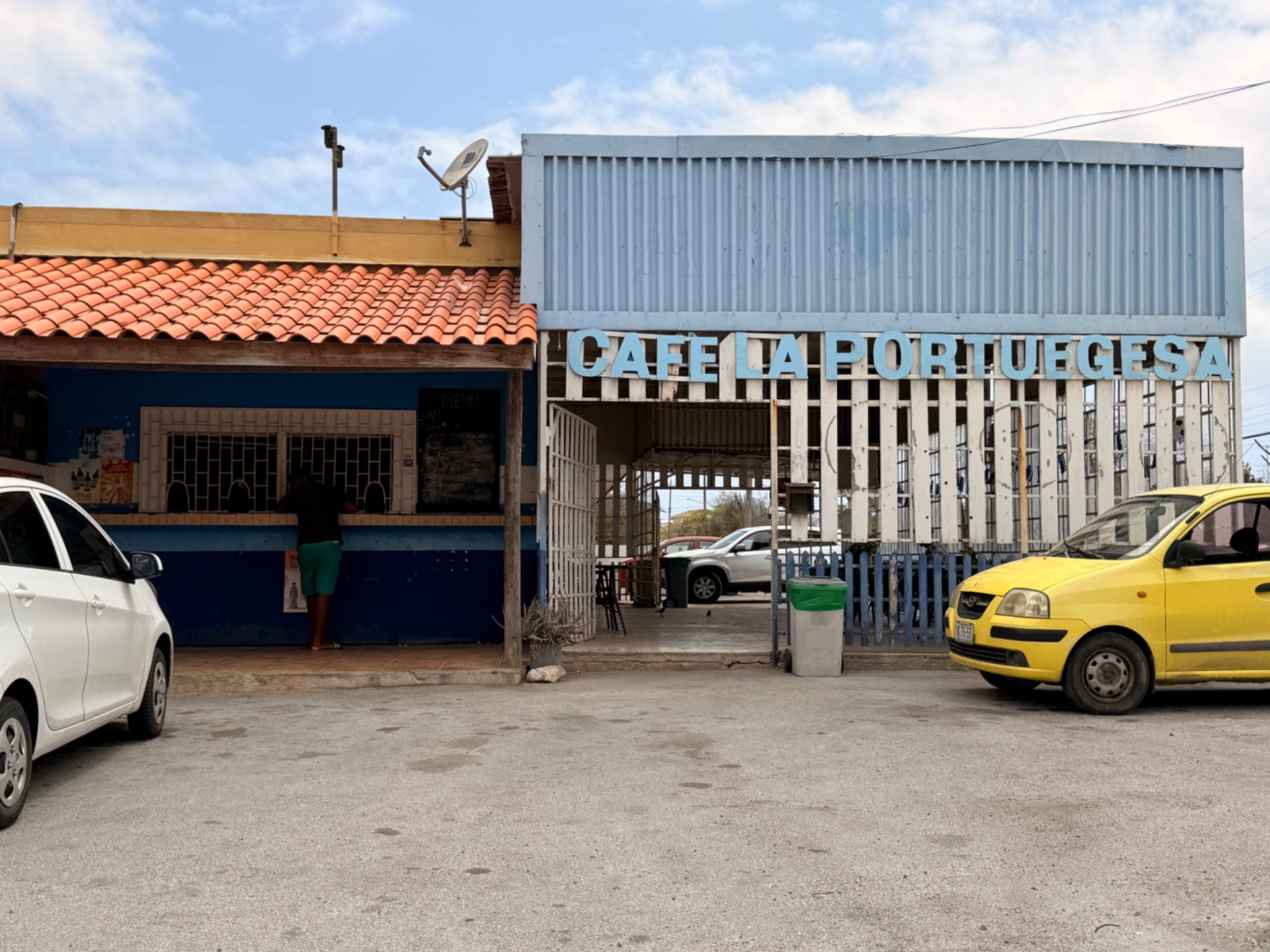
Photo: Cafe La Portuegesa, a real spot on Snekkie
History · 5 min read
What Is a Snekkie? The Soul of Curaçao's Local Food Culture, Explained
Published on May 26, 2026
There is a word in Papiamentu that does not translate cleanly into English, Dutch, or any other language. That word is snekkie — sometimes spelled snèk — and once you understand what it means, you understand something essential about life on Curaçao.
A snekkie is a local neighbourhood bar and snack counter. But that description undersells it in the same way that calling a church "a building with benches" undersells a church. A snekkie is a gathering place, a kitchen, a social club, a news board, and a domino hall — all folded into a modest room that might seat twenty people if everyone holds their breath. It is where the island eats, drinks, argues, laughs, and keeps its stories alive.
This is the guide to understanding what a snekkie actually is. And at the bottom, you will find out how the Snekkie app is mapping every single one of them — because for too long, these places have existed only in local memory, invisible to anyone who did not already know where to look.
What Is a Snekkie?
The word comes from the Dutch snack, passed through Papiamentu with a diminutive suffix to produce snekkie — little snack place. But the concept is entirely local. It did not arrive from the Netherlands or from Venezuela. It grew out of the rhythms of working-class neighbourhood life in Curaçao, somewhere in the twentieth century, and it has been evolving ever since.
A snekkie is not a restaurant. That distinction matters. A restaurant has printed menus, table service, and a bill at the end. A snekkie has a chalkboard or a laminated card on the wall. You walk up to the counter. You say what you want. You pay when you get it. The food comes fast. You eat it standing up, or on a plastic stool, or in your car with the window down.
A snekkie is not a tourist café. The prices — typically five to twenty-five Antillean Guilders per meal — are priced for local workers, not for visitors on a resort budget. Most snekkies are unknown to guidebooks and invisible on Google Maps. They have no website, no Instagram account, and no TripAdvisor page. They run on reputation and relationships, passed through word of mouth across generations.
A snekkie is almost always family-run. The woman at the counter may be the same woman who was at the counter when her mother ran the place thirty years ago. The recipes are not written down; they live in the hands of the people who make the food. That is by design, and it is part of what makes a snekkie irreplaceable.
The Snekkie as Social Institution
In every neighbourhood of Curaçao — in Otrobanda, Seru Fortuna, Marchena, Barber, Lagun, and a hundred smaller kaya intersections across the island — there is a snekkie that functions as the centre of gravity for the street around it. People do not just stop there to eat. They stop there to exist together.
The domino table is the most visible expression of this. Many snekkies keep a domino table — sometimes outside under a tree, sometimes wedged between the counter and the wall — and it is almost never empty during the day. Playing domino in Curaçao is not a casual pastime. It is a serious social ritual, played with speed and strategy and plenty of conversation. Regulars have their spots. There is a hierarchy of who sits where, who plays whom, and who gets to watch. If you show up and want to play, you wait your turn and you do not rush anyone.
The snekkie is also where neighbourhood news circulates. Who is getting married. Who just had a baby. Who is leaving for the Netherlands. Whose nephew just came back. The counter at a well-established snekkie knows more about its surrounding streets than any newspaper ever could, because the people who live those streets eat at that counter every single day.
This social function is what distinguishes a snekkie from a fast-food outlet. You can eat quickly at a snekkie, but nobody is in a hurry for you to leave. The culture is one of lingering — one more cold drink, one more hand of domino, one more story. Time moves differently at a snekkie, and that is entirely intentional.
What You Will Find at a Snekkie
The snekkie day has a clear rhythm, and what you can order shifts with the hour.
Early morning — some snekkies open as early as 5am for workers heading to the construction sites, the port, the fishmarket — means pastechi. These golden fried pastries filled with cheese, tuna, spiced beef, or salted codfish are the defining morning food of Curaçao. They come out of the fryer fresh, they cost one to three Guilders each, and eating them is one of the great small pleasures the island offers. The first tray of the morning sells out fast. Regulars know exactly when it will be ready.
Through the morning and into the afternoon, cold drinks take over: Amstel Bright, Malta, fruit juices, cold water. The refrigerator behind the counter hums constantly. In the Curaçao heat, a cold drink from a snekkie is not a luxury; it is a necessity.
At lunchtime — roughly noon to two, though the timing is flexible — the hot meal appears. This is the heart of the snekkie menu. Stoba (a slow-braised stew of beef, goat, or chicken), funchi (a firm cornmeal porridge similar to polenta),binja (okra cooked with cornmeal), rice, fried fish, and whatever else the kitchen decided to make that morning. The lunch menu is not always posted and it changes daily based on what was available and what the cook felt like making. Ask what is on, point at what looks good, and eat what you are given. It will be excellent.
Snekkies that have a bar component — many do — stay open longer into the evening, serving cold drinks and lighter snacks. Some offer grilled items at night. A few run into the small hours on weekends. But most traditional snekkies wrap up by seven or eight in the evening, because the workday crowd they serve is already home.
The Family Behind the Snekkie
The word "family-run" gets used casually about many businesses. At a snekkie, it means something different. It means that the person frying the pastechi today learned to do it by watching their mother, who learned by watching their grandmother, who came up with the recipe herself in a kitchen that no longer exists. The knowledge is embodied, not documented.
This is why losing a snekkie is not like losing a restaurant. When a restaurant closes, the menu can be recreated somewhere else with the same ingredients and techniques. When a snekkie closes — because the family matriarch retired, or the rent went up, or the children moved to the Netherlands — something specific to that place disappears. The particular seasoning of the stoba. The exact texture of the funchi. The way the pastechi dough was rolled. These are not things that can be found in a cookbook.
The families who run snekkies are, in a very real sense, the custodians of Curaçao's food culture. They have held that knowledge across generations with no fanfare and no recognition. They feed the island every day. They are the backbone of local food life in a way that no upscale restaurant could ever replicate, no matter how good the chef.
Famous Snekkies Worth Seeking Out
Among the hundreds of snekkies scattered across the island, a few have achieved the kind of local renown that survives for decades and becomes part of the neighbourhood's identity.
Netto Bar in Otrobanda is perhaps the most famous. Operating for over seventy years in one of Willemstad's oldest neighbourhoods, Netto Bar has become a cultural landmark — a place that has fed generations of the same families, that has been a fixture through every political and economic shift the island has experienced, and that remains, on any given afternoon, exactly what it has always been: a counter with cold drinks, a domino table, and people who have been coming here their whole lives.
Many other snekkies have their own versions of this story. The neighbourhood place that has been in the same spot for forty years. The one that the whole street knows by the owner's first name. The one where you have to arrive before noon if you want the stoba, because it is always gone by twelve-thirty. These places do not have press coverage or food awards. They have something more durable: loyal regulars who have been eating there since childhood and who will keep doing so until the doors close.
To find them, you need local knowledge — or you need the Snekkie app.
How the Snekkie App Maps Them All
The problem that motivated the creation of snekkie.com is simple: these places are effectively invisible to anyone who does not already know where they are. They do not appear in standard travel guides. They are rarely on Google Maps. They have no digital presence whatsoever. And because they run on word of mouth, they remain accessible mainly to people who grew up nearby.
The Snekkie app was built to change that. It is a community-driven map of local snekkies across Curaçao — added, reviewed, and maintained by people who actually eat at them. Every pin on the map represents a place someone thought was worth sharing. Every detail — the opening hours, the must-order dishes, the parking situation — comes from locals who have been going there for years.
The goal is not to turn snekkies into tourist attractions. The goal is to make the local knowledge that already exists — scattered across personal recommendations and neighbourhood memory — available to anyone who wants to eat the way Curaçao actually eats. That includes visitors who want something real. It includes members of the diaspora coming back to the island after years away. And it includes residents who moved to a new neighbourhood and are still figuring out where to eat.
If you are on the island right now, open the Snekkie map and find what is near you. If you want to go deeper into the snekkie culture, plan a full Snek Tour — a neighbourhood-by-neighbourhood route through the best local spots the island has. Either way: go early, eat hot, and stay for the domino.